
From Market Opportunity to Revenue: Building a Practical International Growth Plan
International expansion can create valuable new revenue streams, reduce dependence on the domestic market and strengthen a company’s long-term position. However, identifying an attractive market is only the beginning.
Many SMEs invest considerable time researching countries, attending trade shows and speaking to potential distributors, yet struggle to convert this activity into sustainable revenue. The problem is rarely a complete lack of opportunity. More often, the company has not built a practical plan connecting the market opportunity to customers, channels, sales activity and financial results.
For CEOs, the central question should not simply be, “Is there demand in this market?” It should be, “Can we build a profitable and repeatable business in this market?”
Start with a clear commercial objective
An international growth plan should begin with a defined business objective. Entering a new market is too demanding to be treated as a general ambition.
Leadership should agree what the expansion is expected to achieve. This might include:
Generating a defined level of revenue within 18 months
Reducing reliance on one existing market or customer
Establishing a distribution network in a priority region
Testing demand before making a larger investment
Building a platform for wider regional expansion
The objective will influence the investment level, route to market, internal resources and performance measures.
A company seeking £500,000 in distributor-led sales will require a very different plan from one intending to establish a local office and build a direct sales team.
Select markets based on evidence
Market size is important, but it is not enough. A large market may also have intense competition, complex regulation, high customer-acquisition costs or demanding service requirements.
A practical market assessment should consider:
The size and growth of the target customer segment
Customer needs and buying behaviour
Existing competitors and substitutes
Pricing levels and expected margins
Regulatory and certification requirements
Potential routes to market
The availability of suitable partners
The company’s ability to support customers locally
The best market is not always the largest. It is the market where customer demand, competitive positioning and internal capability create the strongest probability of profitable success.
CEOs should also avoid entering several markets simultaneously without sufficient resources. For most SMEs, selecting one or two priority markets and learning from those markets is more effective than spreading investment too thinly.
Define the target customer
A market is not a customer segment. Describing the opportunity as “Germany”, “the food sector” or “European manufacturers” is too broad to guide commercial activity.
The company must define the customers most likely to buy first. This may include factors such as company size, sector, location, current supplier, purchasing priorities and operational challenges.
The strongest target segments usually have three characteristics:
A clear and urgent problem
A strong fit with the company’s offering
A realistic route for reaching decision-makers
This focus improves marketing, prospecting and partner selection. It also helps the company create a more relevant value proposition.
Adapt the value proposition
A product that performs well in the home market may still require different positioning abroad.
Customers in the new market may prioritise different benefits. One market may value price and delivery speed, while another places greater emphasis on quality, compliance, technical support or sustainability.
The value proposition should explain:
The customer problem being solved
The measurable commercial or operational benefit
Why the offering is different from local alternatives
What evidence supports the claim
Why the customer should act now
Generic messages such as “high quality”, “innovative” or “excellent service” are rarely enough. The value proposition must be specific, credible and relevant to the target customer.
Choose the right route to market
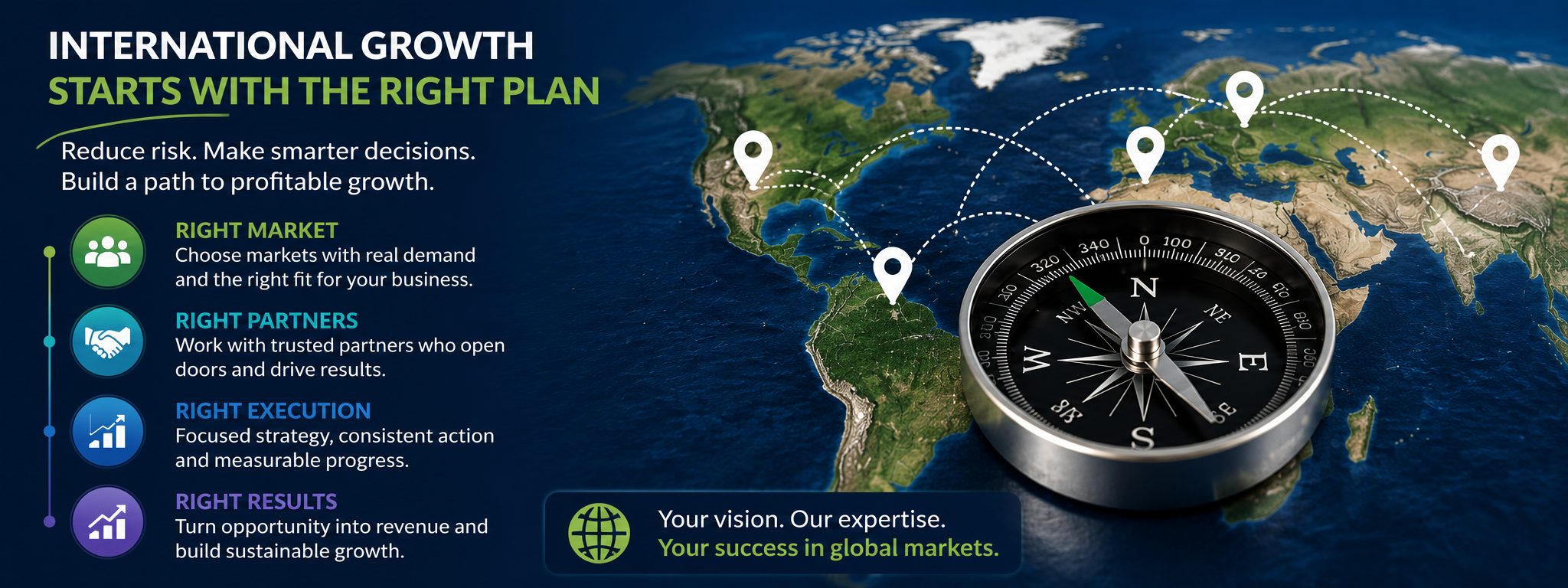
The route to market determines how the company reaches, sells to and supports customers.
Options may include direct sales, distributors, agents, strategic partners, online channels or a combination of these. Each model has different implications for cost, control, speed and profitability.
Distributors can provide local relationships, market knowledge and customer access. However, appointing a distributor does not transfer responsibility for market development. The exporter must still provide training, marketing support, sales tools, pricing guidance and performance management.
Before appointing a partner, the company should define clear selection criteria. These may include sector experience, customer coverage, technical capability, financial stability and willingness to invest in developing the market.
Exclusivity should be earned through performance, not granted automatically at the start of the relationship.
Build a realistic financial model
Revenue projections should be based on commercial activity rather than optimism.
A practical forecast should connect:
Target customers
Average order value
Sales cycle length
Conversion rates
Channel margins
Marketing and travel costs
Logistics, duties and compliance costs
Payment terms and working-capital requirements
The business must understand its true cost to serve the new market. A sale that appears attractive may become unprofitable after distributor discounts, freight, technical support, returns and extended payment terms are included.
Leadership should establish minimum margin expectations and clear pricing authority before active selling begins.
Turn strategy into a 90-day action plan
A market-entry strategy only creates value when it drives action.
The first 90 days should include specific activities, owners and deadlines. These might include:
Validating the target segment through customer interviews
Finalising pricing and market positioning
Developing localised sales materials
Building a qualified prospect list
Identifying and assessing potential partners
Launching structured outreach
Creating a sales pipeline in the CRM
Setting weekly and monthly KPIs
Regular management reviews should assess activity, customer feedback, pipeline quality, conversion and margin.
Focus on learning as well as revenue
Early market-entry activity should generate both sales opportunities and market intelligence. Customer conversations may reveal that the product, pricing, messaging or channel strategy needs adjustment.
This should not be viewed as failure. Controlled learning is one of the main advantages SMEs have over larger competitors. They can often adapt more quickly.
The key is to make adjustments based on evidence rather than reacting to individual opinions or isolated conversations.
Conclusion
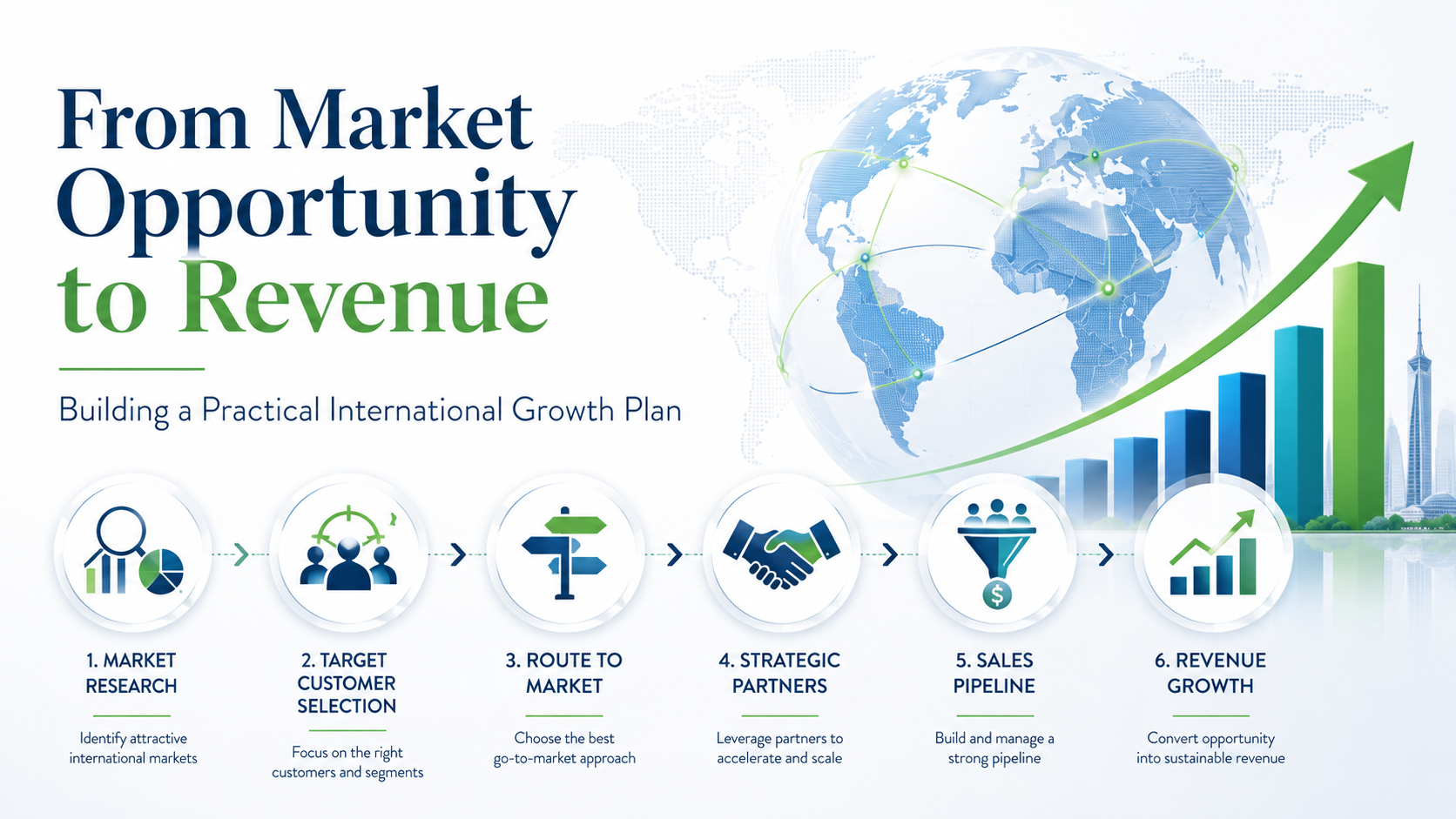
International growth does not happen simply because a market opportunity exists. It requires a structured commercial plan that connects market selection, customer needs, positioning, route to market, sales activity and financial control.
For CEOs of SMEs, the goal should be to create a focused and repeatable growth model. Start with one clearly defined opportunity, validate it with customers, select the right route to market and measure progress consistently.
A practical international growth plan turns research into action, action into pipeline and pipeline into profitable revenue.
Planning your next international move?
OpenVentures Consulting helps SMEs assess new-market opportunities, develop practical market-entry strategies, identify and qualify suitable partners, and turn international growth plans into commercial action.
To discuss how your business can enter and grow in new markets with greater clarity and lower risk, contact OpenVentures Consulting:
Email: sales@openventuresconsulting.com
Telephone: +353 86 8303703
Website: www.openventuresconsulting.com