
How to Prioritise International Markets: Choosing Where to Invest First
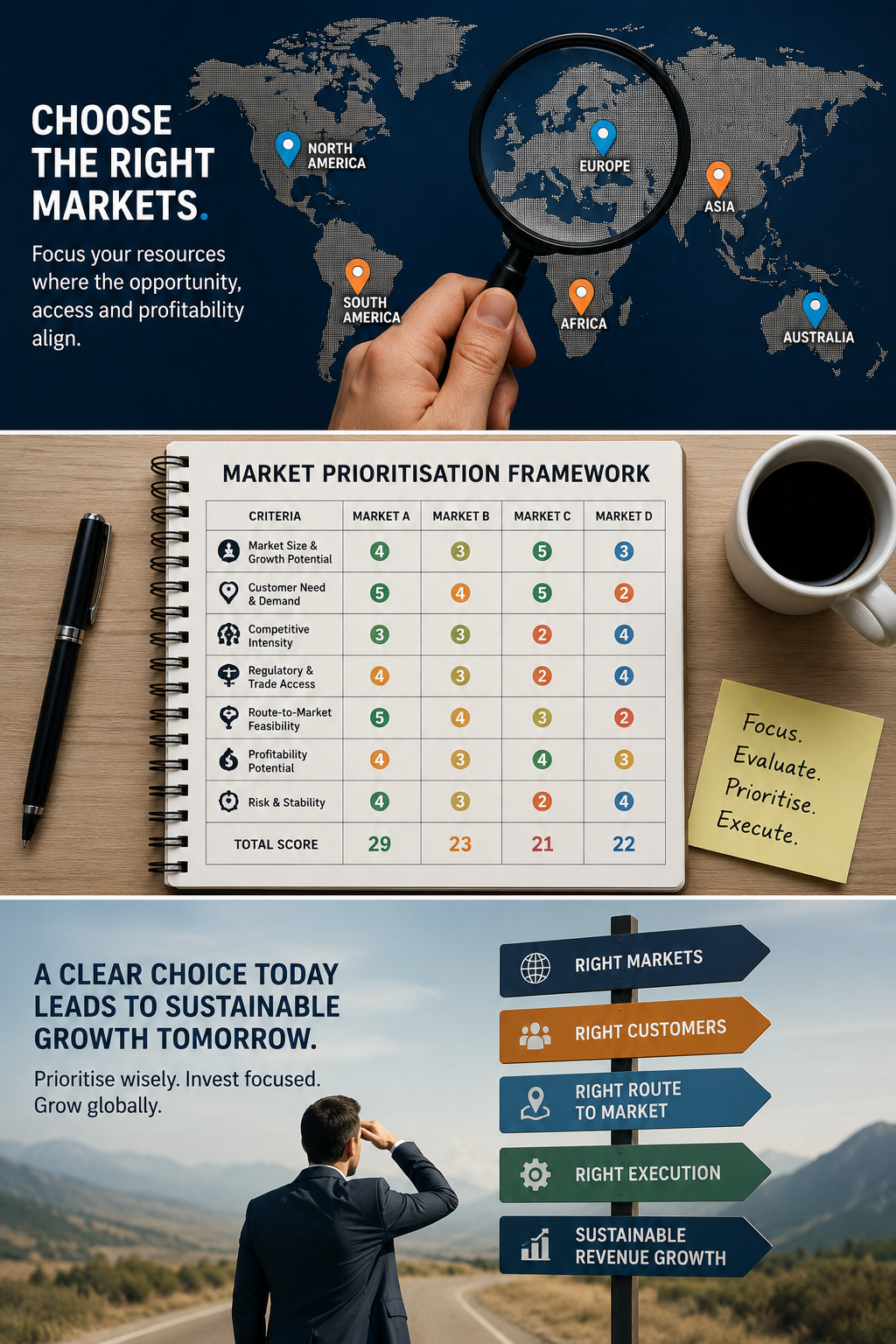
Choosing the Right International Markets for SME Growth
Part 2 of the OpenVentures Consulting “From Market Opportunity to Revenue” series
International expansion can unlock significant growth for SMEs, but choosing the wrong market can be expensive.
One of the most common mistakes companies make is assuming that the largest market, the fastest-growing economy or the nearest country must be the best place to expand. In reality, market attractiveness is only one part of the decision.
For CEOs of SMEs, the more useful question is:
Where does market opportunity align with our ability to compete, execute and generate profitable revenue?
Resources are finite. Management time, sales capacity, marketing budgets and working capital can quickly become stretched if a business tries to enter several markets simultaneously.
A structured market-prioritisation process helps leadership focus investment where the probability of success is highest.
1. Start with your international growth objective
Before comparing countries, clarify what you want international expansion to achieve.
Are you trying to:
Generate new revenue?
Reduce dependence on your domestic market?
Follow existing customers into new territories?
Access a faster-growing customer segment?
Establish a foothold in an important region?
Build a platform for broader European, Middle Eastern or global expansion?
Your objective matters because different markets may be attractive for different reasons.
A company seeking rapid revenue may favour a market with strong existing demand and an accessible distribution network. Another business may accept slower initial growth because a particular country offers strategic access to a wider region.
Without a clear objective, market selection can quickly become driven by personal preference, anecdotal information or whichever opportunity happens to appear first.
2. Assess real customer demand
Market size can be misleading.
A country may represent a multibillion-euro market, but only a small proportion of that opportunity may be relevant to your business.
Instead, assess the accessible market.
Ask:
How many customers fit our ideal customer profile?
Is this segment growing?
What specific problems are customers trying to solve?
Are they actively buying solutions like ours?
What alternatives are they currently using?
What are typical purchasing volumes and contract values?
Who makes the buying decision?
For many SMEs, a smaller market containing a concentrated group of highly relevant prospects can be more attractive than a large but fragmented market.
The objective is not to find the market with the biggest headline number. It is to identify where there is real, reachable demand.
3. Understand the competitive landscape
Competition is not necessarily negative. Established competitors often indicate that a genuine market exists.
However, CEOs need to understand whether their company has a credible reason to win.
Evaluate:
Local and international competitors
Market leaders
Pricing levels
Customer loyalty
Existing distributor relationships
Service expectations
Product or capability gaps
Barriers to switching suppliers
Then ask one critical question:
Why would a customer change from their existing supplier and choose us?
If the answer is unclear, the market may require significant product adaptation, stronger positioning or greater investment than expected.
4. Evaluate your route to market
Even strong demand is of limited value if reaching customers is difficult or uneconomic.
Understand how customers buy within each market.
Possible routes include:
Direct sales
Distributors
Agents
Strategic partners
Resellers
E-commerce
Marketplaces
Hybrid sales models
Each option has implications for speed, margin and control.
A distributor can provide market knowledge and customer relationships, but will expect margin and support. Direct selling provides greater control but usually requires more internal resources.
Before prioritising a market, ask whether there is a realistic and scalable route to customers.
5. Calculate the true cost of market entry
Revenue potential alone should never determine priority.
The real question is whether the business can generate acceptable margins after all market-entry costs are considered.
These may include:
Regulatory approval
Certification
Product adaptation
Translation and localisation
Freight and warehousing
Distributor margin
Local marketing
Travel
Sales resources
Customer service
Extended payment terms
A €1 million revenue opportunity can quickly become less attractive if the cost to serve the market is disproportionately high.
For CEOs and CFOs, profitability potential should carry as much weight as revenue potential.
6. Assess strategic and operational fit
Some markets simply fit the organisation better.
You may already have relevant customer relationships, language capability, industry experience or logistical advantages in one region.
Consider:
Existing contacts
Internal market knowledge
Language capability
Management bandwidth
Product suitability
Operational capacity
Ability to provide local support
Brand relevance
International expansion should strengthen the business rather than overwhelm it.
If entering a market requires capabilities the organisation does not currently possess, those gaps should be recognised before investment begins.
7. Use a market-prioritisation scorecard
A simple scorecard can transform market selection from opinion into structured decision-making.
Score each market from 1–5 against criteria such as:
Market Attractiveness
Size, growth and customer demand.
Competitive Environment
Competitive intensity and differentiation potential.
Ease of Entry
Regulation, compliance and trade barriers.
Route-to-Market Feasibility
Availability of suitable channels and partners.
Profitability Potential
Pricing, margins and cost to serve.
Strategic Fit
Alignment with your capabilities and long-term objectives.
The criteria can then be weighted according to their importance to the company.
The purpose is not to create a perfect mathematical answer. It is to expose assumptions, compare markets consistently and encourage better management conversations.
8. Validate before committing
Desktop research should narrow the opportunity, not make the final decision.
Once two or three priority markets emerge, validate your assumptions.
Speak with:
Potential customers
Distributors
Industry associations
Local experts
Potential strategic partners
Test your value proposition. Ask about pricing. Understand the buying process. Explore the objections you are likely to face.
A relatively small amount of primary research can prevent a significant amount of wasted investment.
Prioritise before you expand
For most SMEs, entering one or two markets properly is more effective than maintaining a superficial presence across six.
The process should be:
Prioritise → Validate → Enter → Measure → Adapt → Scale
The right international market is not necessarily the biggest or fastest growing.
It is the market where customer demand, competitive advantage, route to market, profitability and your ability to execute align.
That is where opportunity has the strongest chance of becoming sustainable revenue.
Planning your next international market?
OpenVentures Consulting helps SMEs evaluate and prioritise international markets, assess routes to market, identify suitable partners and build practical market-entry strategies.
If you are deciding where your business should expand next, contact us to discuss how we can help you reduce risk and focus investment on the markets with the strongest commercial potential.
sales@openventuresconsulting.com
www.openventuresconsulting.com