
Choosing the Right Route to Market: Direct Sales, Distributors or Strategic Partners?
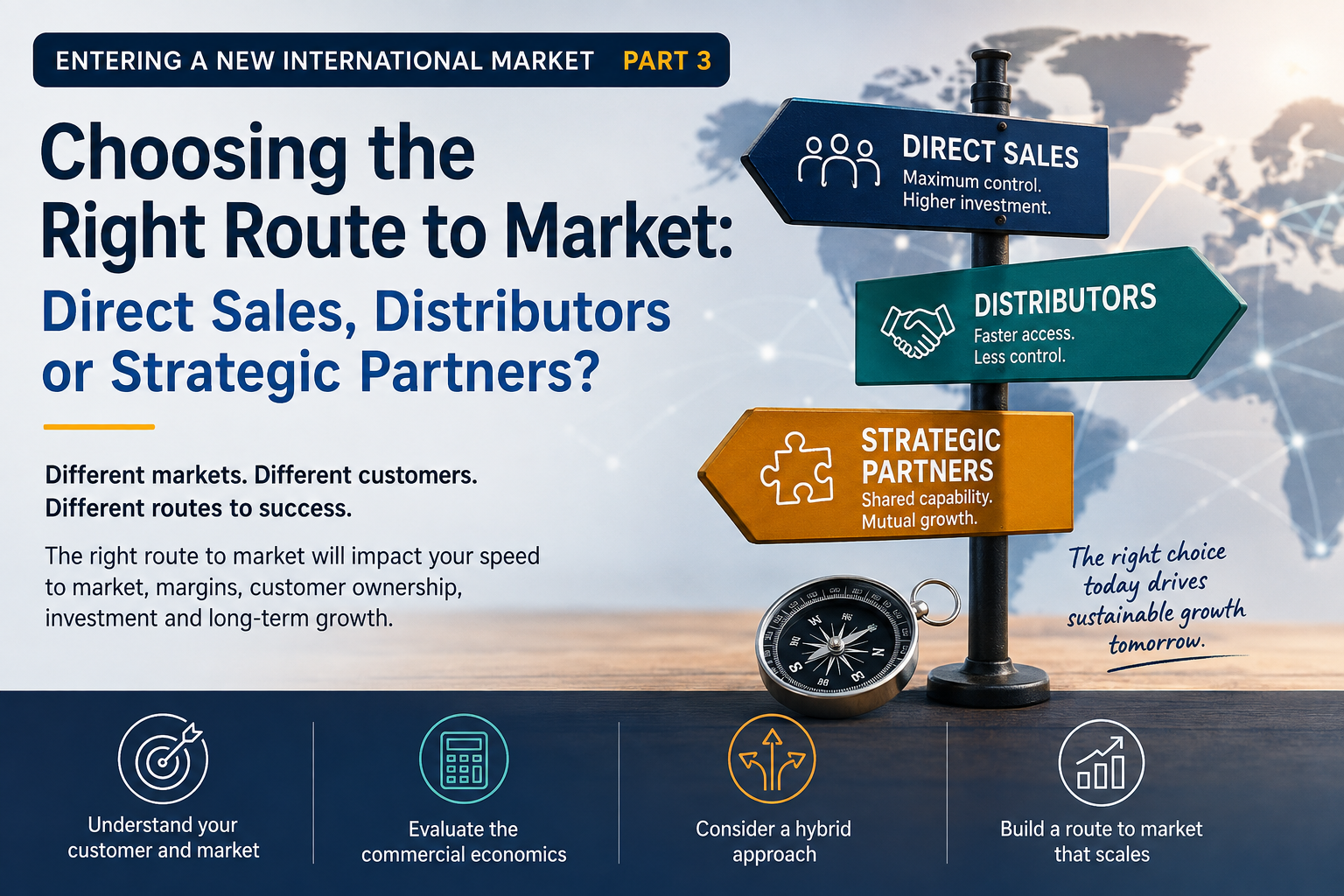
Route to Market Choices
A Practical Framework for International Expansion
Part 3: Entering a New International Market
This is the third article in our Entering a New International Market series. Having looked at how to prioritise markets and how to validate an opportunity before investing, the next critical decision is deciding how you are going to reach customers and generate revenue.
Should you sell directly? Appoint a distributor? Work with an agent? Develop a strategic partnership? Or combine several approaches?
Choosing the right international route-to-market strategy can have a major impact on speed to market, margins, customer ownership, investment requirements and long-term growth.
There is no single model that works in every market. The right choice depends on the customer, the characteristics of the market, the complexity of your product or service and your own internal capabilities.
For leadership teams, the objective is to find the right balance between control, cost, speed and commercial return.
Direct Sales in International Markets: Greater Control, Greater Investment
A direct sales model gives a company the greatest control over its international customers and commercial strategy.
You own the customer relationship, control pricing and positioning and receive first-hand market feedback. This can be particularly valuable for technical, high-value or complex products where customers require a consultative sales process.
Direct sales can also protect margin because there is no distributor taking a percentage of the sale.
However, greater control generally requires greater investment.
You may need dedicated sales resources, local-language support, technical capability, marketing investment and potentially a legal presence in the market.
Direct sales can be particularly appropriate where:
customer relationships are strategically important;
there is a relatively small number of high-value target accounts;
the product requires technical or consultative selling;
margins justify direct investment;
retaining control of pricing and brand positioning is important.
The critical question is not simply whether direct sales offers the highest margin.
It is whether you have the resources, capabilities and time required to build the market yourself.
Using Distributors for International Market Entry
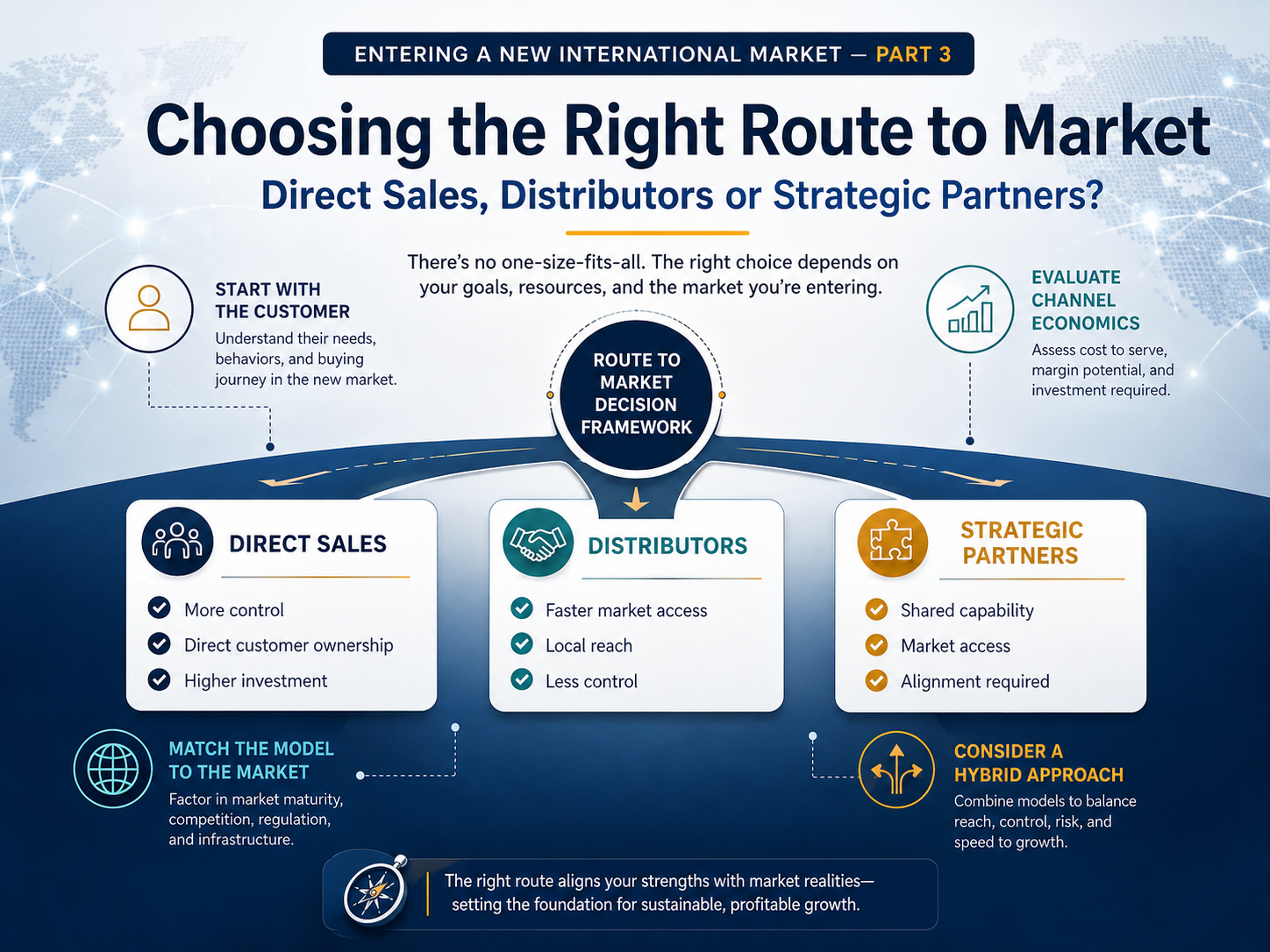
International Market Entry Framework
For many SMEs, appointing an international distributor is an attractive way to enter a new market.
An established distributor may already have customers, salespeople, market knowledge and local credibility. They may also provide warehousing, logistics, technical support and after-sales service.
This can significantly reduce the cost and complexity of international expansion and accelerate access to the market.
But speed comes with trade-offs.
Distributors require margin. They may represent multiple suppliers and your products may be only one part of their portfolio. You will also have less direct control over the customer relationship, sales process and sometimes pricing.
One of the biggest mistakes exporters make is believing that appointing a distributor transfers responsibility for developing the market.
It does not.
Successful international distributors need clear objectives, product training, sales support, marketing activity, agreed KPIs and regular management.
A distributor route-to-market model may be appropriate where:
local relationships are important;
customers prefer purchasing from local suppliers;
the market contains a large number of smaller customers;
local stockholding or support is required;
your business has limited resources to establish direct operations.
Selecting the right distributor is therefore as important as deciding to use the distributor model itself.
Strategic Partnerships for International Expansion
A strategic partnership can provide another effective route into a new international market.
Partners may include complementary product providers, technology companies, local industry specialists or businesses already serving your target customers.
The advantage is the ability to combine capabilities.
A partner may offer customer access, market knowledge, credibility or infrastructure that would take considerable time and investment to develop independently.
You may bring specialist expertise, intellectual property, technology or a differentiated product that enhances their existing proposition.
Strategic partnerships can be especially valuable in markets where trust, regulation or technical integration creates significant barriers to entry.
However, partnerships require careful structuring.
Management teams need clarity on customer ownership, commercial responsibilities, intellectual property, pricing, exclusivity, investment and long-term objectives.
A partnership based only on enthusiasm rather than clear commercial alignment can quickly lose momentum.
Start Your Route-to-Market Strategy With the Customer
One of the most important principles in international market entry is that the route-to-market decision should not start with:
“Which option is easiest for us?”
It should start with:
“How does the customer want to buy?”
Purchasing behaviour can vary significantly between countries.
In one market, customers may routinely deal directly with manufacturers. In another, established distributors may control access to the customer base.
Customers may expect local-language support, short delivery times, local technical assistance, extended payment terms or an existing relationship before they will consider switching supplier.
These factors should be understood during the market-validation stage.
The best route to market is ultimately the one that fits both customer expectations and your commercial objectives.
Calculate the Economics of International Market Entry
Every route-to-market model creates different economics.
Direct sales may provide higher gross margins but require significant upfront investment.
Distributors reduce infrastructure requirements but require sufficient margin to make the relationship attractive to them.
Strategic partnerships may accelerate market access but involve revenue sharing or additional operational complexity.
Before making a decision, leadership teams should model:
realistic sales volumes;
gross margin after distributor or partner costs;
sales and marketing investment;
customer acquisition costs;
local support requirements;
logistics and fulfilment costs;
working capital requirements;
expected time to break-even.
A route that appears to deliver the highest revenue may not necessarily deliver the best commercial return.
Consider a Hybrid International Sales Model
International expansion does not always require choosing one route exclusively.
Many successful companies use hybrid models.
You might manage large strategic accounts directly while appointing distributors to service smaller customers.
You might initially enter a market through a local partner and move towards direct sales once demand has been proven.
Different channels can also work for different products, customer groups or regions within the same country.
The important point is that this evolution should be strategic rather than accidental.
Choose Your International Route to Market Based on Evidence
Choosing the right route to market is one of the most important decisions in international expansion.
The wrong model can result in weak margins, limited market coverage, poor customer insight and disappointing sales.
The right model can accelerate growth while controlling both risk and investment.
Before committing, leadership teams should understand the customer buying process, competitive landscape, channel economics and internal resources required to make each option successful.
At OpenVentures Consulting, we help businesses develop practical international route-to-market strategies. This includes assessing direct sales opportunities, identifying and evaluating distributors and strategic partners, validating customer demand and building market-entry plans designed to convert international opportunity into sustainable revenue.
Planning to Enter a New International Market?
Before choosing a distributor, recruiting a salesperson or committing significant investment, make sure you have identified the route to market that gives your business the strongest commercial opportunity.
Contact OpenVentures Consulting to assess your market-entry options, identify the right international partners and build a practical route-to-market strategy.